
NBI Clearance Color for Abroad 2026: White, Yellow, Blue, Red Meaning

Quick Answer:
For overseas employment, visa applications, and POEA requirements, you need WHITE NBI Clearance (labeled “Multi-Purpose” or “No Derogatory Record”). Yellow clearance is for local use only and will NOT be accepted abroad. Blue clearance has a notation about resolved cases. Red clearance indicates a pending case and cannot be used for employment abroad.
Submitted the wrong NBI Clearance color? It could delay your overseas job or even cause visa rejection.
The color of your NBI Clearance is not just for appearance—it shows your record status and determines whether it will be accepted for international use. Recruitment agencies, POEA, and foreign embassies have strict rules, and choosing the wrong one can lead to delays or denied applications.
In this guide, you’ll quickly learn what each NBI Clearance color means, which one is required for overseas employment, and how to make sure you get the correct clearance the first time.
What Are NBI Clearance Colors?
NBI Clearance certificates in the Philippines use color coding to show a person’s criminal record status. The color is not just for design it helps employers, government offices, and immigration officers quickly see whether someone has a clean record or any legal issues.
The Four NBI Clearance Colors:
- White – No derogatory record (clean clearance)
- Yellow – For local use only (limited clearance)
- Blue – With notation (case dismissed or already resolved)
- Red – With pending case or active warrant
Important Note: As of 2026, the NBI has standardized the clearance design. Some older clearances may look slightly different in color style, but the meaning of each color remains the same nationwide.
Your clearance color is automatically determined during the verification process based on:
- Results of your fingerprint scan (AFIS system)
- Existing records in the NBI database
- Pending cases or active warrants
- Previous criminal records or case history
- Name matches or “hits” that require further verification
You cannot choose your NBI Clearance color. It is assigned based on your actual record status.
Visual Identification of NBI Clearance Colors
Here’s how you can visually identify each NBI Clearance color:
- White Clearance: Printed on plain white paper or with a white background and black text. Usually labeled “Multi-Purpose” or “No Derogatory Record.”
- Yellow Clearance: Printed on yellow-tinted paper or with a yellow border. Marked “For Local Use Only.”
- Blue Clearance: Printed on blue-tinted paper or with a blue border. Contains notation text explaining that a case was dismissed or resolved.
- Red Clearance: Printed with red-tinted paper or red warning indicators. Clearly states “With Pending Case.”
The color is easy to see as soon as you receive your clearance certificate at the NBI office.
1. WHITE NBI CLEARANCE (MULTI-PURPOSE) – FOR ABROAD
What is White NBI Clearance?
White NBI Clearance, labeled “Multi-Purpose,” is given to applicants with no criminal record, no pending cases, and no derogatory information in the NBI database. This is considered a clean clearance.
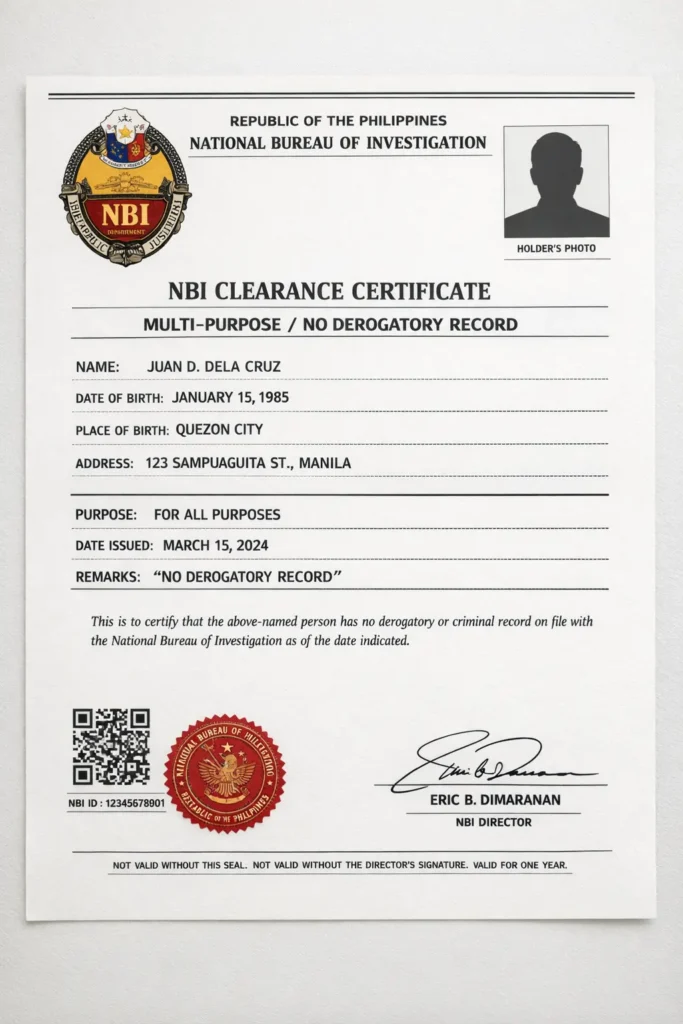
Official labels may include:
- “Multi-Purpose”
- “No Derogatory Record”
- “No Criminal Record”
What It Means
- Clean criminal record
- No fingerprint matches in the NBI system
- No name matches (“hits”)
- No warrants of arrest
- No unresolved legal issues
Accepted For
White clearance is accepted for:
- Overseas employment (OFW processing)
- POEA certification and deployment
- All visa applications
- Immigration and migration
- Professional licensing abroad
- Foreign university applications
- Work and residence permits worldwide
- Local employment and government transactions
POEA & Embassy Requirement
POEA strictly requires white Multi-Purpose clearance for OFWs. Other colors (yellow, blue, red) will be rejected.
Foreign embassies such as the USA, Canada, Australia, UK, Schengen countries, Japan, Korea, Singapore, Hong Kong, New Zealand, and Middle Eastern countries also require white clearance.
Validity for Abroad
Although officially valid for one year, most agencies and embassies require clearance issued within the last 6 months. It is best to apply 2–3 months before deployment or visa interview.
How to Get White Clearance
You will receive white clearance automatically if:
- You have no criminal record
- You have no pending cases
- Your fingerprints do not match any criminal records
- Any name “hits” have been cleared
You cannot choose the color. It depends on your record status.
2. YELLOW NBI CLEARANCE (LOCAL USE ONLY)
What is Yellow NBI Clearance?
Yellow clearance is marked “For Local Use Only.” It is restricted to domestic use and cannot be used internationally.
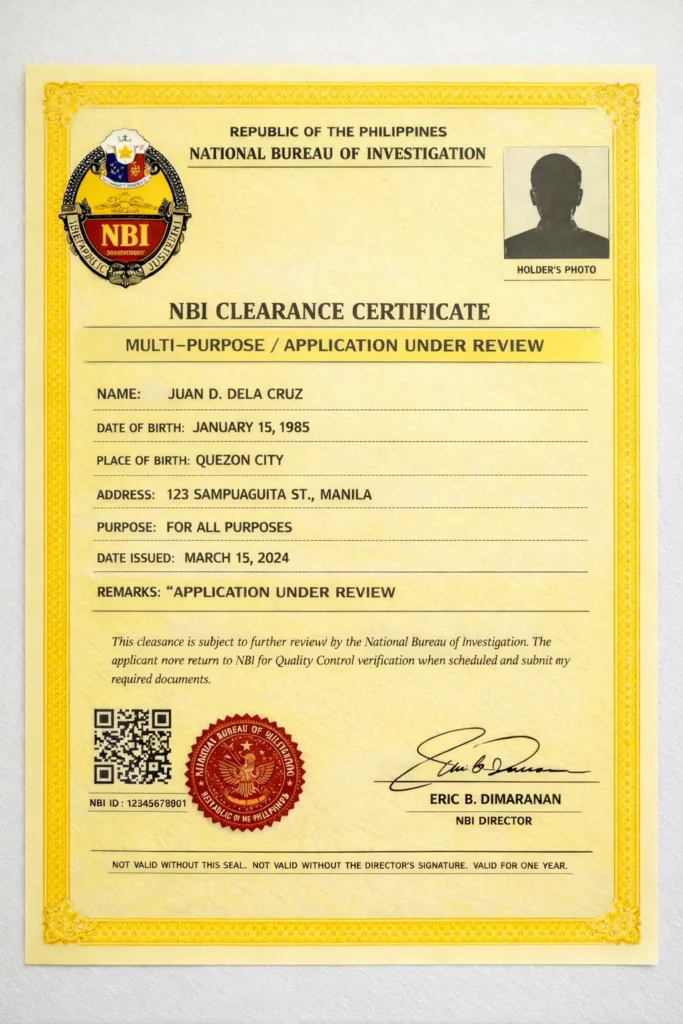
Official labels may include:
- “For Local Use Only”
- “Local Clearance”
What It Means
Yellow clearance may be issued due to:
- Minor name matches
- Incomplete or unverified background data
- First-time applicant flags
- Minor administrative notes
Important: Yellow clearance does not automatically mean you have a criminal record. It simply limits usage to the Philippines.
Not Accepted For
- Overseas employment
- POEA processing
- Visa applications
- Embassy submissions
- Immigration or migration
- Work permits abroad
May Be Accepted For
- Local employment (depending on employer)
- Some government transactions
- Barangay or municipal requirements
Important Warning
Do not use yellow clearance for overseas or visa applications. It will be rejected and may cause delays, visa denial, or job cancellation.
If you need white clearance but received yellow, ask the NBI officer for the reason and follow instructions to resolve the issue.
3. BLUE NBI CLEARANCE (WITH NOTATION)
What is Blue NBI Clearance?
Blue clearance is issued to applicants who previously had a case that has been dismissed, resolved, or closed. It includes a notation explaining the case status.
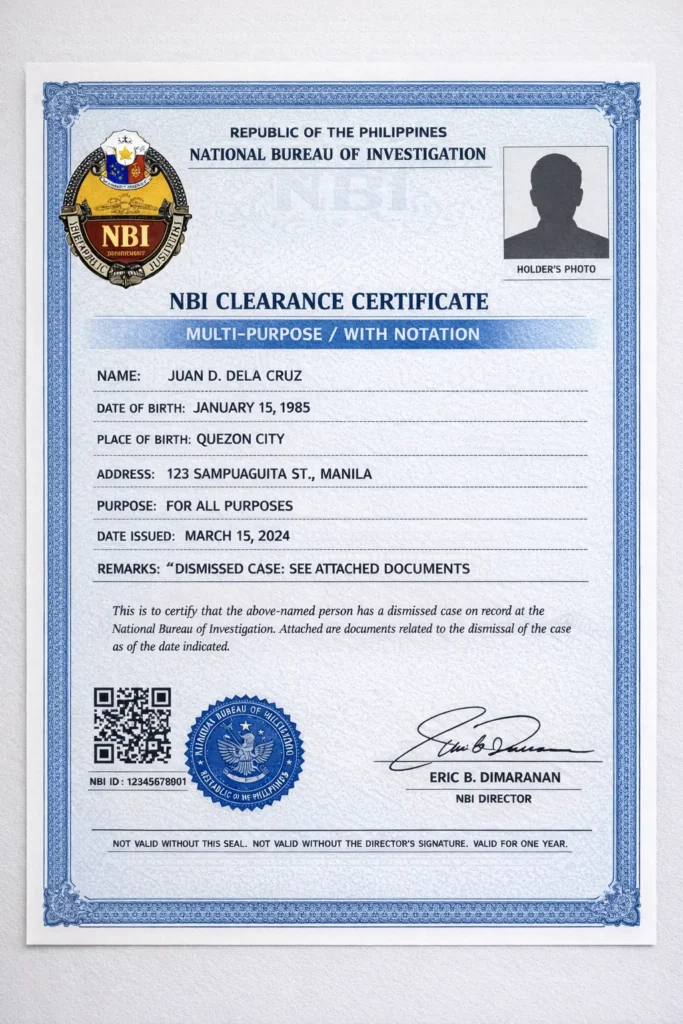
Official labels may include:
- “With Notation”
- “Case Dismissed”
- Specific case details
What It Means
- You previously had a case filed
- The case was dismissed, acquitted, or resolved
- You have no pending charges
- You are legally cleared, but the record remains noted
Common notations include:
- “No Pending Criminal Case”
- “Case Dismissed – [Court Name]”
- “Acquitted – [Case Number]”
Acceptance
Usually accepted for:
- Local employment
- Some government transactions
- Domestic business permits
May or may not be accepted for:
- Overseas employment
- Visa applications
- POEA processing (case-by-case basis)
Generally not accepted for high-security or sensitive jobs. If planning to work abroad with blue clearance, consult your recruitment agency or POEA first.
4. RED NBI CLEARANCE (WITH PENDING CASE)
What is Red NBI Clearance?
Red NBI Clearance is issued to applicants who have active pending criminal cases, warrants of arrest, or unresolved legal matters. This is the most restrictive type of clearance.
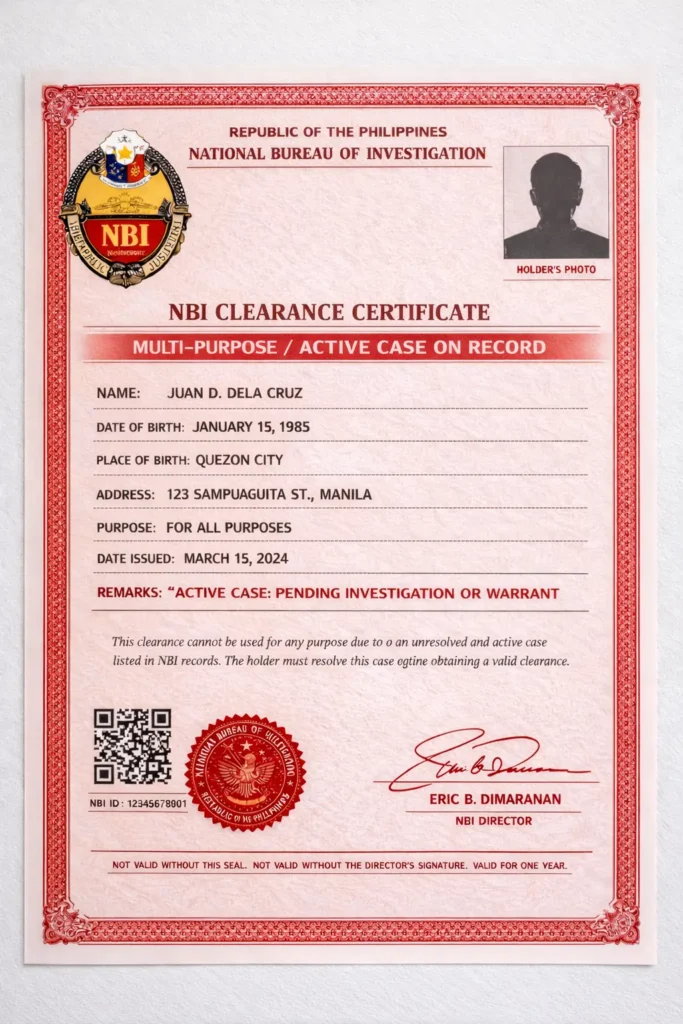
Official Labels on the Certificate:
- “With Pending Case”
- “Active Warrant of Arrest”
- “For Reference Only”
- Includes specific case details
What Red Clearance Means
- You currently have an active criminal case in court
- There may be an outstanding warrant of arrest under your name
- You have unresolved legal issues
- You are facing criminal charges or prosecution
- Authorities may be looking for you
Red clearance is basically a denial of full clearance. It officially shows that you have pending legal issues.
Information Shown on Red Clearance
The certificate usually includes:
- Case number
- Court where the case is filed
- Nature of the offense
- Issuing authority
- Date of warrant or case filing
This information helps you identify and resolve the legal matter.
Not Accepted For
Red clearance cannot be used for:
- Overseas employment
- POEA processing
- Visa applications
- Immigration or migration
- Any job requiring clearance
- Professional licensing
- Government positions
- Firearm permits
- Adoption proceedings
- Security-sensitive jobs
It is not valid for employment or official transactions.
What Red Clearance Can Be Used For
Red clearance can only serve as:
- Official proof that you have a pending case
- A reference document for your lawyer
- Evidence of case existence for court proceedings
If You Receive Red Clearance
You must act immediately:
1. Read the Details Carefully
- Take note of the case number, court, and charges
- Understand what legal issue exists
2. Consult a Lawyer Immediately
- Do not try to handle it alone
- A lawyer will guide you on proper legal steps
3. Contact the Issuing Court
- Visit or call the court listed on the clearance
- Confirm the case details and status
- Check if it is legitimate or a possible mistake
4. Resolve the Legal Matter
- If the case is legitimate, address it through proper legal process
- If it is a namesake or mistaken identity, secure court certification
- Submit proof of resolution to NBI for record updating
5. Do Not Attempt to Work Abroad
- Red clearance means you cannot legally process overseas employment
- You may be stopped at immigration
Common Reasons for Red Clearance
- You have a legitimate pending case
- Namesake issue (someone with the same name has a case)
- An old warrant you were unaware of
- A case filed in another province
- Identity theft or fraudulent case filing
Resolution Time
Fixing red clearance may take:
- 1–3 months for namesake issues (with proper documents)
- 6–12 months or longer for legitimate cases requiring court resolution
- The timeline depends on court schedules and case complexity
You cannot obtain white clearance until the legal issue is fully resolved and officially documented.
6. Color Comparison Table
Quick Reference: NBI Clearance Colors
| Color | Status | Accepted for Abroad | Limitations |
|---|---|---|---|
| White | No Derogatory Record (Clean) | ✓ Yes – All countries ✓ Required by POEA ✓ Accepted for all visas | None |
| Yellow | Local Use Only | ✗ No – Rejected ✗ POEA will deny ✗ Embassies reject | Cannot be used abroad For local use only |
| Blue | With Notation (Case Dismissed) | ? Maybe – Case by case ? Depends on country ? Check with agency | May require explanation May need court documents Limited acceptance |
| Red | With Pending Case / Active Warrant | ✗ No – Prohibited ✗ Absolute POEA denial ✗ Embassy rejection | Cannot be used for overseas employment Active legal issues |
Key Takeaway for Overseas Employment
- White = Required
- Yellow = Rejected
- Blue = Uncertain (always check requirements first)
- Red = Not allowed / Impossible for overseas use
Why Clearance Color Matters for Overseas Employment
The color of your NBI Clearance can directly affect whether you are allowed to work abroad. It is not just a design difference — it determines if your application will be accepted or rejected.
Legal and Regulatory Reasons
1. POEA Requirement
- POEA rules require “Multi-Purpose” (white) clearance.
- This is stated in official POEA Memorandum Circulars.
- If you submit the wrong color, your application will be automatically rejected.
2. Host Country Immigration Laws
- Most destination countries require a clean criminal record.
- Labor agreements include a “no criminal record” condition.
- Immigration laws may deny entry to individuals with pending cases.
3. Bilateral Employment Agreements
- Agreements between the Philippines and host countries require white clearance.
- This ensures only qualified and law-abiding workers are deployed.
- It protects both the worker and the receiving country.
Practical Business Reasons
1. Employer Requirements
- Foreign employers require clean background checks.
- Company policies usually demand white clearance.
- This reduces security risks and legal liability.
2. Work Permit and Visa Processing
- Embassies check your clearance color during visa review.
- Work permit offices verify criminal status.
- The wrong color can lead to visa denial.
3. Deployment Timeline
- White clearance allows smooth and faster processing.
- Yellow, blue, or red clearance can cause delays or cancellations.
- You may lose time-sensitive job offers.
Consequences of Submitting the Wrong Clearance
If you submit yellow, blue, or red clearance for overseas employment, you may face:
- POEA application rejection
- Visa denial
- Job offer withdrawal
- Deployment cancellation
- Financial losses (processing fees, medical exams, training)
- Damaged application record
- Possible deportation if deployed improperly
Real-World Examples
Scenario 1: Yellow Clearance
Maria applied for a nursing job in Saudi Arabia. POEA rejected her application because she had yellow clearance. She had to reapply for white clearance, causing a 2-month delay and losing her original job offer.
Scenario 2: Blue Clearance
Juan had a dismissed traffic case and received blue clearance. The embassy required court documents and an explanation letter. His processing was delayed by 3 months, but he eventually deployed after submitting complete documents.
Scenario 3: Red Clearance
Ana discovered she had a pending case due to identity theft. She could not apply for overseas work and spent 8 months resolving the issue. After dismissal, she received blue clearance and finally deployed after about one year.
The color of your NBI Clearance is not cosmetic. It determines whether you can legally process overseas employment and work abroad.
Philippine Overseas Employment Administration (POEA) Requirements for NBI Clearance Color
POEA has strict and non-negotiable rules about NBI Clearance color for all OFWs.
Official Requirement
All applicants for overseas employment must submit an NBI Clearance with:
- “Multi-Purpose” classification
- “No Derogatory Record” status
This means:
- White clearance – Mandatory
- Yellow clearance – Rejected
- Blue clearance – Case-by-case evaluation
- Red clearance – Absolutely prohibited
When POEA Checks Your Clearance
POEA verifies your clearance multiple times:
- Initial Application Screening
- Clearance color checked immediately
- Wrong color stops the application
- Medical Examination Stage
- Clinics check clearance validity and color
- Wrong color prevents medical clearance
- Pre-Departure Orientation Seminar (PDOS)
- Clearance checked again before attendance
- Must still be white and valid
- Final POEA Clearance (Before OEC Issuance)
- Final verification
- Must remain white and valid
- Airport Immigration
- Immigration officers may check clearance
- Wrong color may result in offloading
Validity Requirements
POEA requires NBI Clearance that is:
- Issued within the last 6 months
- Valid on the deployment date
- Classified as White “Multi-Purpose”
- Original copy (photocopies not accepted)
What Happens If You Submit the Wrong Color
Yellow Clearance
- Application rejected immediately
- Cannot proceed with POEA processing
- Must obtain white clearance first
Blue Clearance
- Sent for legal review
- Must submit court dismissal order, prosecutor’s resolution, and other certified documents
- Review takes 2–4 weeks
- Approval depends on case type, country rules, job type, and time since dismissal
Red Clearance
- Automatic rejection
- Cannot apply for overseas work
- Must fully resolve the legal case before reapplying
No Exemptions
POEA does not grant exceptions, even for:
- Urgent deployment
- High-demand skills
- Emergency replacements
White clearance is always required.
How to Check If Your Clearance Is POEA-Compliant
Before submitting:
- Confirm the color is white
- Check it says “Multi-Purpose”
- Ensure it states “No Derogatory Record”
- Verify issue date (within 6 months)
- Confirm it is still valid
- Submit the original copy
- Check for official NBI signature and seal
If all are correct, your clearance meets POEA standards.
For updated requirements, always check directly with POEA as policies may change.
Embassy and Visa Requirements by Country
Different countries have specific rules about NBI Clearance color when applying for visas. In most cases, white clearance (“Multi-Purpose” with No Derogatory Record) is required
Strict White Clearance Requirement (No Exceptions)
The following countries generally require white clearance only for all major visa types:
United States
- Tourist visa (B1/B2) – White required
- Work visas (H1B, L1, etc.) – White required
- Immigrant visas – White required
- Clearance color is strictly checked
Canada
- Work permit – White mandatory
- Study permit – White required
- Permanent residence – White required
- Provincial nominee programs – White required
Australia
- All visa types – White only
- Blue clearance may require extra police clearance from Australian authorities
United Kingdom
- Work visa – White required
- Student visa – White required
- Strict immigration rules
Schengen Countries (European Union)
- All Schengen visas – White required
- Work permits and residency – White mandatory
- Includes Germany, France, Italy, Spain, Netherlands, and others
Japan
- Technical Intern Training – White only
- Specified Skilled Worker visa – White required
- Engineer/Specialist visas – White mandatory
South Korea
- E-9 Employment Permit System – White required
- Other work visas – White mandatory
Singapore
- Work permit – White required
- Employment pass – White required
New Zealand
- Work visa – White required
- Residency – White required
Case-by-Case Evaluation Countries
Middle Eastern Countries (Saudi Arabia, UAE, Qatar, Kuwait, Oman, Bahrain)
- Prefer white clearance
- May accept blue clearance if:
- Court dismissal documents are provided
- Employer approves
- Embassy agrees
- Yellow and red are not accepted
Hong Kong
- White preferred
- Blue may be accepted for some jobs with extra documents
Taiwan
- White standard requirement
- Blue evaluated case-by-case
- Explanation documents required
Tourist Visa Considerations
For short-term tourist visas:
- Most countries still require white clearance
- Some may consider blue clearance if the case was minor and fully dismissed
- Yellow and red clearances are rejected
Best practice: Always submit white clearance to avoid delays or rejection.
How to Verify Embassy Requirements
Before applying for a visa:
- Visit the official embassy website
- Download the visa checklist
- Call the embassy visa section
- Send an email inquiry
- Confirm with the official visa application center
Always verify directly with the embassy. Do not rely on secondhand information.
How to Ensure You Get White Clearance
Follow these steps to increase your chances of receiving white “Multi-Purpose” NBI Clearance.
Before Applying
1. Make Sure You Have No Legal Issues
- Check if you have any pending criminal cases
- Confirm there are no outstanding warrants
- Ensure no traffic violations have escalated into criminal cases
- Contact courts in places where you previously lived if unsure
2. Resolve Any Legal Problems First
- Settle pending cases before applying
- Secure court dismissal orders if applicable
- Clear any warrants or summons
- Pay fines for minor violations
3. Update Your Personal Records
- Make sure your IDs show consistent details
- Update your address if you moved
- Correct name or birthdate errors in official documents
4. Prepare Important Documents
- Bring PSA-certified birth certificate
- Bring multiple valid government IDs
- Bring old NBI clearances (if available)
- Prepare proof of identity
During NBI Application
1. Provide Accurate Information
- Use your exact legal name from your birth certificate
- Enter correct birth date and birthplace
- Provide accurate address details
2. Complete Biometric Capture Properly
- Arrive on time
- Provide clear fingerprints
- Follow instructions during photo capture
- Answer questions honestly
3. If You Get a “Hit” (Name Match)
- Stay calm — most hits are due to namesakes
- Submit required documents
- Return for Quality Control verification if scheduled
- Provide proof that you are not the person with the case
After Application
If You Receive Non-White Clearance
- Ask the NBI officer for the reason
- Request instructions on how to upgrade
- Follow official resolution procedures
For Namesake Issues
- Submit additional identification documents
- Provide proof you are not the person involved
- Execute an affidavit if required
- Return for re-evaluation
For Previously Resolved Cases
- Submit certified court dismissal orders
- Provide prosecutor’s resolution
- Present official case closure documents
- Request record updating if applicable
How to Maintain White Clearance in the Future
- Avoid involvement in criminal activity
- Resolve legal matters immediately
- Keep court and legal documents organized
- Renew your clearance before expiration
- Monitor your records to ensure there are no errors
White clearance depends on your actual legal status, but proper preparation and accurate documentation greatly reduce delays and issues.
Common Mistakes That Cause Non-White Clearance
- Not properly updating records after a dismissed or resolved case
- Pending traffic violations that escalated into warrants
- Having the same or similar name as someone with a criminal record (namesake issue)
- Failing to update NBI after a case has been resolved
- Identity theft cases that were never reported or corrected
- Errors or incorrect information in previous NBI applications
How to Prevent Non-White Clearance
- Regularly check your legal status
- Resolve any legal issues immediately
- Keep all court and legal documents organized
- Update NBI records after any case dismissal or resolution
If you have never been involved in criminal activity and have no pending legal issues, you should automatically receive white “Multi-Purpose” clearance.
What to Do If You Get the Wrong Clearance Color
If you receive yellow, blue, or red clearance when you expected white especially if you need it for overseas employment follow these steps immediately.
Step 1: Ask Why
Before leaving the NBI office, ask:
- Why did I receive this clearance color?
- What issue caused this classification?
- Can I upgrade to white clearance?
- What documents do I need to submit?
Get clear answers right away.
Step 2: Identify the Issue
If Yellow Clearance
- First-time application with limited data
- Minor system or verification issue
- Administrative flag
If Blue Clearance
- Previous case that was dismissed or resolved
- Old case still reflected in the NBI database
If Red Clearance
- Active pending case
- Outstanding warrant
- Unresolved legal matter
- Namesake issue
Step 3: Gather Required Documents
Yellow to White Upgrade
- Multiple valid IDs
- PSA birth certificate
- Proof of residence
- Previous NBI clearances (if any)
- Employment or school records
Blue to White Upgrade
- Certified court dismissal order
- Prosecutor’s resolution
- Certificate of finality (if available)
- Other official court documents
Red Clearance
- Consult a lawyer immediately
- Secure court documents
- Resolve the legal case
- Provide proof if it is a mistaken identity
Step 4: Follow NBI Procedures
- Visit the NBI Legal Division or Quality Control Section
- Submit required documents
- Fill out forms and pay necessary fees
- Attend scheduled verification
- Comply with all additional requirements
Step 5: Reapply If Needed
If upgrade is not possible:
- Resolve the issue first
- Apply again for a new clearance
- Submit proof of resolution
Timeline Expectations
- Yellow to White: 1–2 weeks (simple issues)
- Blue to White: 2–6 weeks (document verification required)
- Red to White: Several months or longer (depends on legal resolution)
For Urgent Deployment
If your job abroad is urgent:
- Inform NBI about your deadline
- Request expedited processing (if available)
- Show proof of job offer or flight booking
- Coordinate with your recruitment agency
Do not attempt to use the wrong clearance color. It will be rejected.
Important Reminder
- Blue clearance may sometimes be accepted with full court documents (depends on country).
- Yellow and red clearances must be resolved before overseas processing.
Prevent Future Issues
- Keep copies of all court and resolution documents
- Update NBI records after case resolution
- Apply early for future clearances
- Keep your records organized
Most clearance color issues can be resolved with proper documentation and patience.
{ “@context”: “https://schema.org”, “@graph”: [ { “@type”: “Article”, “headline”: “NBI Clearance Color Guide for Abroad 2026: Official Requirements”, “description”: “Complete guide to NBI Clearance colors and their meanings, with specific requirements for overseas employment and international travel”, “author”: { “@type”: “Organization”, “name”: “NBI Appointment” }, “datePublished”: “2026-02-11”, “dateModified”: “2026-02-11”, “articleSection”: “Government Documents”, “keywords”: [“NBI clearance color”, “NBI abroad”, “overseas employment clearance”] }, { “@type”: “FAQPage”, “mainEntity”: [ { “@type”: “Question”, “name”: “What color NBI Clearance is required for abroad?”, “acceptedAnswer”: { “@type”: “Answer”, “text”: “White (Multi-Purpose) NBI Clearance is required for overseas employment and international purposes. This indicates ‘No Derogatory Record’ and is the only color accepted by POEA, embassies, and foreign employers.” } }, { “@type”: “Question”, “name”: “What do the different NBI Clearance colors mean?”, “acceptedAnswer”: { “@type”: “Answer”, “text”: “White = No derogatory record (clean clearance for all purposes). Yellow = Local use only (for basic employment within Philippines). Blue = With notation (case dismissed or resolved). Red = With pending case or active warrant (cannot be used for employment abroad).” } }, { “@type”: “Question”, “name”: “Can I use yellow NBI Clearance for overseas employment?”, “acceptedAnswer”: { “@type”: “Answer”, “text”: “No. Yellow clearance is for local use only and will not be accepted by POEA, foreign employers, or embassies. You must obtain white (multi-purpose) clearance which shows no derogatory record.” } }, { “@type”: “Question”, “name”: “How do I get white NBI Clearance instead of yellow?”, “acceptedAnswer”: { “@type”: “Answer”, “text”: “To get white clearance, you must have no criminal record, no pending cases, and no hits during verification. If you receive yellow, check if there are unresolved issues in your record. Ensure all previous cases are properly dismissed and documented.” } }, { “@type”: “Question”, “name”: “Is red NBI Clearance acceptable for abroad?”, “acceptedAnswer”: { “@type”: “Answer”, “text”: “No. Red clearance indicates a pending case or active warrant and cannot be used for any employment purpose, local or abroad. You must resolve the legal issue first before applying for overseas employment.” } } ] }, { “@type”: “Table”, “about”: “NBI Clearance Color Meanings and Uses”, “description”: “Comprehensive table showing NBI clearance colors, their meanings, validity, and accepted uses” } ] }Conclusion
The color of your NBI Clearance is not just a visual detail — it determines whether you can move forward with overseas employment, visa applications, or other important processes. White “Multi-Purpose” clearance is the standard requirement for working abroad, while yellow, blue, and red clearances have limitations that can delay or block your plans.
Always check your clearance color carefully before submitting it to POEA, embassies, or employers. If you receive the wrong color, act immediately to understand the reason and follow proper steps to resolve it. Being proactive, organized, and informed will help you avoid delays and secure the correct clearance the first time.
FAQs
What color is the NBI Clearance for overseas workers (OFWs)?
The NBI Clearance for OFWs or overseas employment is yellow and marked “For Abroad.” It’s the version recognized by embassies and foreign employers.
Can I apply for NBI Clearance for abroad while outside the Philippines?
Yes. You can request it through the nearest Philippine Embassy or Consulate, though processing may take several weeks.
Can I use a scanned or photocopied NBI Clearance for abroad?
No. Only the original, printed yellow document is accepted for authentication and embassy submission.
How long does it take to process an NBI Clearance for abroad?
Usually 15–30 minutes at the NBI office if there’s no “HIT” status. You can then proceed with DFA authentication afterward.
What color NBI Clearance do I need for overseas employment?
You need WHITE NBI Clearance labeled “Multi-Purpose” or “No Derogatory Record” for overseas employment. This is mandatory for POEA processing and visa applications. Yellow, blue, and red clearances are not accepted for OFW deployment.
Can I use yellow NBI Clearance to work abroad?
No. Yellow clearance is marked “For Local Use Only” and will be rejected by POEA, embassies, and foreign employers. You must obtain white clearance to work overseas.
What does blue NBI Clearance mean?
Blue clearance means you previously had a criminal case that has been dismissed, acquitted, or resolved. The “With Notation” designation explains the case status. While the case is closed, the historical record remains in the NBI database.
Can I work abroad with blue NBI Clearance?
It depends. Some countries and employers may accept blue clearance if you provide certified court dismissal documents and the case was minor. However, white clearance is strongly preferred. Consult with your recruitment agency and destination country requirements.
Why did I receive yellow clearance when I have no criminal record?
Yellow clearance may be issued to first-time applicants, those with limited data in the NBI system, or due to administrative flags. Contact NBI to understand the specific reason and request upgrade to white clearance with supporting documents.
How do I upgrade from yellow to white clearance?
Visit the NBI Quality Control Section with additional identification documents (PSA birth certificate, multiple valid IDs, proof of residence). Submit upgrade request and follow their procedures. Processing typically takes 1-2 weeks.
Can I change my blue clearance to white clearance?
Generally, no. If you have a dismissed case, NBI will maintain the notation. However, some very old cases or minor matters may qualify for record updating. Consult NBI Legal Division with your court documents.
What documents do I need to upgrade blue clearance?
To attempt upgrading blue clearance, bring certified true copies of court dismissal order, prosecutor’s resolution, certificate of finality, and any court documents proving case closure. NBI will evaluate on a case-by-case basis.
How long is white NBI Clearance valid for overseas employment?
While white clearance is technically valid for one year, POEA requires clearance issued within 6 months of deployment. Most embassies also prefer clearance issued within 3-6 months for visa applications.
What if I receive red clearance due to mistaken identity?
If you believe red clearance is due to a namesake or mistaken identity, consult a lawyer immediately. You’ll need to obtain court certification proving you are not the person with the pending case, then submit this to NBI for verification and record correction.
ow do I know what color clearance I have?
The color is visible on the paper certificate itself—it will be white, yellow, blue, or red. The classification is also printed on the certificate as “Multi-Purpose,” “For Local Use Only,” “With Notation,” or “With Pending Case.”