
What is Complexion in NBI Form? 7 Color Options Explained (2026)
Quick Answer:
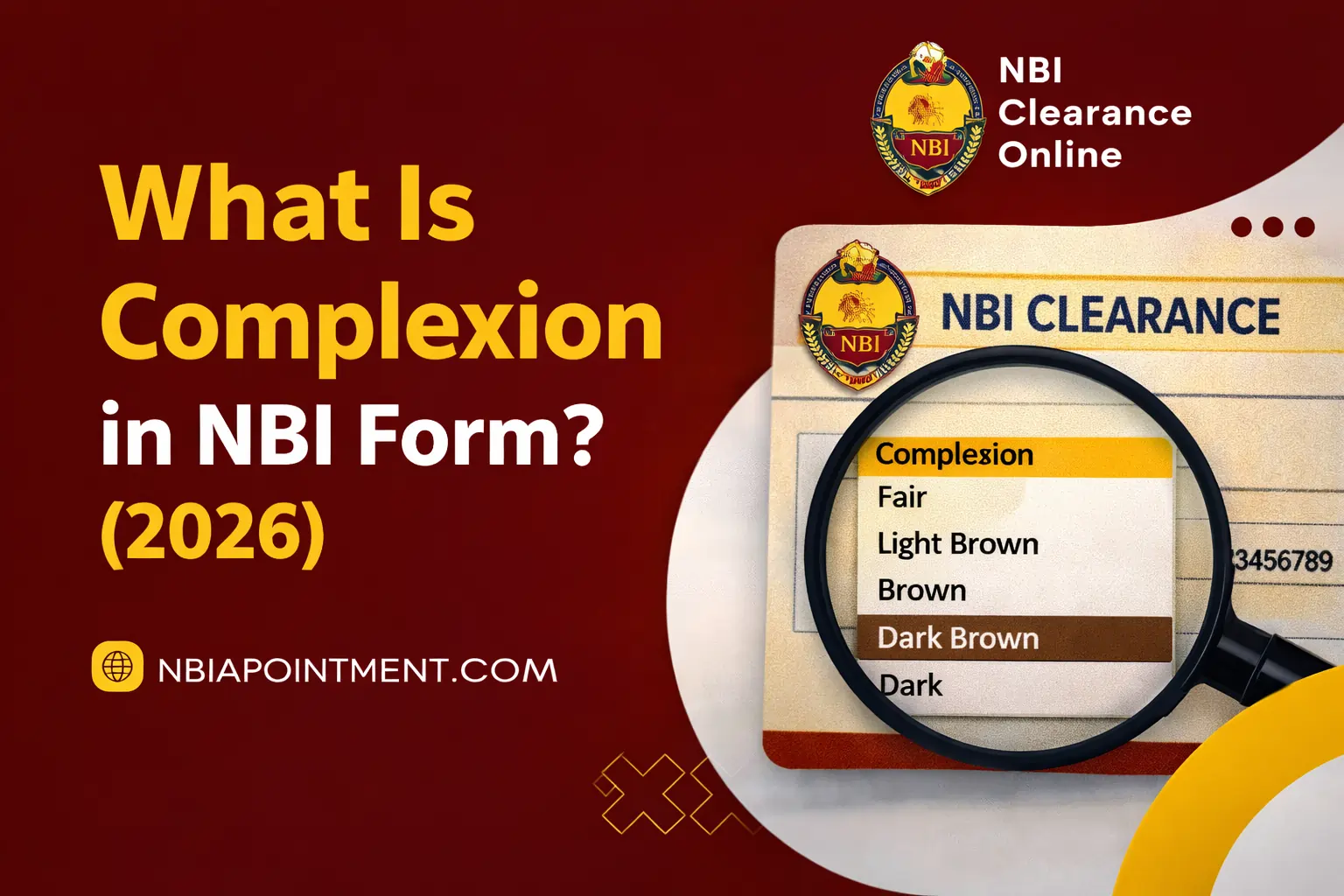
In the NBI Clearance form, Complexion means your natural skin color. Choose the option that best matches how your skin looks in real life: Fair, Light Brown, Brown, Dark Brown, Black, or Yellow. Avoid guessing; select the tone that matches your actual appearance during biometrics.
When applying for an NBI Clearance in the Philippines, you will see a question in the form asking for your “complexion.” Many applicants feel unsure about this part and wonder what it really means.
Simply put, complexion refers to your natural skin tone. The NBI form gives several color options to help describe your appearance for identification purposes.
In this 2026 guide, you’ll learn what complexion means in the NBI form, the 7 color options you can choose from, how to select the correct one, and why this detail is important for your NBI clearance application.
What Does Complexion Mean in the NBI Form?
In your NBI Clearance application, complexion simply means your natural skin color or skin tone. It has nothing to do with beauty standards, race, or ethnicity. It is only used to help identify you.
The NBI includes your complexion in your personal record along with details like height, weight, eye color, and identifying marks. These details help tell people apart, especially if several individuals have the same or similar names.
Think of complexion as one small part of your identity record. Just like your photo and fingerprints, it helps the NBI make sure your clearance is matched to the correct person.
Why Is Complexion Important in Your NBI Clearance?
Complexion is Important in Your NBI Clearance for below reasons:
Identity Verification:
Many Filipinos share the same names. Your complexion helps NBI officers tell people apart when names are similar, along with other physical details.
Accurate Record Keeping:
Your complexion is stored in your NBI record together with your height, weight, and other identifiers. This helps keep your record correct for background checks, job applications, visa processing, and future renewals.
Fraud Prevention:
Including complexion details adds an extra layer of security. It helps prevent identity theft and makes it harder for someone else to use your NBI clearance.
Faster Processing:
When your information is accurate, NBI staff can verify your identity more quickly during in-person processing, helping avoid delays.
Important: Choosing a complexion does NOT affect approval or denial of your NBI clearance. It is only used for identification and is not a screening or judgment factor.
Having this detail ensures your NBI Clearance remains unique and traceable, especially during nbi renewals or future checks.
The 7 Complexion Color Options Explained
The NBI uses simple and general categories to describe complexion. While the exact options may look slightly different on paper forms or online systems, these are the 7 most common complexion types you will see in 2026.

1. Fair complexion nbi
Fair complexion refers to light or pale skin that may look pinkish or creamy. People with fair skin usually appear lighter than average and may get sunburned easily. This skin type often shows redness under strong sunlight and does not tan quickly. Choose this option if your skin looks clearly lighter than most people in natural daylight.
2. White complexion nbi
White complexion describes very light or extremely pale skin, even lighter than fair. This skin tone may look almost porcelain-like and is less common in the Philippines. It is often seen in people with very light natural skin or minimal sun exposure. Choose this option only if your skin is noticeably lighter than fair; if unsure, Fair is usually the safer choice.
3. Yellow complexion nbi
Yellow complexion refers to light to medium skin with a warm, yellow, or golden undertone. The skin may appear golden when seen in natural sunlight. This undertone is common among many Asians and is defined more by color tone than by how light or dark the skin is. Choose this option if your skin has a natural yellow or warm golden appearance.
4. Brown complexion nbi
Brown is the most common complexion option in the Philippines and includes medium tan to medium brown skin tones. This skin type often looks naturally tanned or sun-kissed. Many Filipinos, especially those who spend time outdoors, fall into this category. Choose Brown if your skin tone is medium and you are often described as kayumanggi, moreno, or morena.
5. Dark Brown complexion nbi
Dark Brown refers to skin that is darker than standard brown but not the darkest option available. The skin appears deep brown, tans easily, and rarely burns under the sun. This option fits people whose skin tone is clearly darker than medium brown but not extremely dark.
6. Dark complexion nbi
Dark complexion includes very dark brown to black skin tones. The skin has strong pigmentation and appears deep in color. People with this complexion usually tan deeply and rarely experience sunburn. Choose this option if your natural skin tone is very dark.
7. Red complexion nbi
Red complexion is the least common option and refers to skin with a natural reddish or rosy undertone. This is not caused by sunburn, heat, or temporary flushing. The redness is naturally present in the skin tone. Choose this option only if your skin consistently appears reddish by nature.
Important Reminder
Choose the complexion that best matches your natural skin tone. Your selection does not affect NBI clearance approval and is used only for identification purposes.
| Complexion Option | Description | When to Select |
|---|---|---|
| Fair | Very light or pale skin tone | If your skin is noticeably light or pale |
| Light Brown | Slightly tan or medium skin tone | If your skin is medium or lightly tan |
| Brown | The typical Filipino complexion | If your skin matches common Filipino skin tone |
| Dark Brown | Deep brown or darker skin color | If your skin is naturally darker |
| Black | Very dark complexion | If your skin is very dark |
| Yellow | Yellowish undertone complexion | If your skin has a noticeable yellow/golden undertone |
Your complexion is not a personal preference or opinion simply select the option that best matches your natural tone.
How to Choose the Right Complexion for Your NBI Form?
Choosing your complexion is simple if you follow these easy steps:
1. Check Your Skin in Natural Light
Look at your skin in daylight, near a window or outside. Avoid artificial lights because they can change how your skin color looks. Natural light shows your true skin tone.
2. Focus on Your Normal Skin Tone
Choose based on how your skin looks on a normal day. Do not consider temporary changes like sunburn, tanning, makeup, or skincare treatments.
3. Pick the Closest Option
The complexion choices are general, not exact. You don’t need a perfect match—just choose the option that is closest to your skin tone. If you’re between two, pick the one that feels more accurate.
4. Think About How Others Describe You
Consider how people usually describe your skin. If friends or family call you morena, moreno, or maputi, use that as a guide.
5. Be Honest and Stay Consistent
Select the option that truly matches your appearance. This is only for identification, not beauty. Try to use the same complexion when you renew your NBI clearance in the future.
6. Don’t Overthink It
You don’t need to be exact. The NBI only needs a general description. Make your best choice and continue with your application.
How to fill Out Complexion Field in Your NBI Application Step-by-Step?
For Online NBI Applications:
- Log in to your NBI Clearance account on the official website
- Start a new application or renewal
- Go to the Personal Information section
- Look for the “Complexion” field, usually near height, weight, and other physical details
- Choose the option from the dropdown that best matches your skin tone
- Double-check all your details before submitting
- Finish your application and schedule your appointment
For Manual or Walk-In Applications:
Manual or walk-in applications are used when an applicant does not complete the NBI clearance form online. In this case, the applicant visits an NBI Clearance Center without an online appointment and fills out the application form on-site.
This option is usually chosen by:
- Applicants who are not comfortable using the online system
- Those who do not have internet access
- Applicants who need assistance filling out the form
- Individuals correcting errors or incomplete details in their application
During a walk-in application, NBI staff will help verify your personal details, and you will manually complete the required information before proceeding to biometrics and payment. However, walk-in applicants often experience longer waiting times compared to those who book an online appointment.
Tip: To save time and avoid long queues, completing the NBI form online before visiting the branch is strongly recommended.
Can You Change or Correct Your Complexion in NBI Records?
Yes, you can request a correction if the complexion on your record was entered incorrectly. This sometimes happens when applying online or if the encoder selects the wrong option.
To fix it:
- Visit the same NBI branch where your clearance was processed.
- Bring your valid ID and current NBI Clearance.
- Inform the information desk about the correction request.
Once verified, the NBI will update your complexion record in their database. It’s a quick process, but you should always double check details before submitting your form to avoid needing corrections later.
Is Complexion the Same as Race or Ethnicity?
No. “Complexion” and “race” are two completely different things.
Complexion refers only to your skin tone, while race or ethnicity relates to cultural or genetic background.
The NBI doesn’t record ethnicity it simply uses complexion to help identify individuals visually. Everyone, regardless of race or nationality, is categorized the same way based on appearance. This makes the process fair, simple, and consistent for all applicants.
What Happens If You Leave the Complexion Field Blank?
Leaving this field blank might cause issues or delay your application. The NBI system requires all identification fields to be complete before processing. If you’re applying online, the system won’t let you move forward unless you fill in the complexion section.
For walk in or assisted applications, the encoder may ask you to confirm your complexion before proceeding. It’s a small detail but an essential one.
Is Complexion Automatically Filled in During Biometric Capture?
In many NBI branches, the staff encoders automatically assign your complexion during the photo and biometric capture. They visually assess your appearance and record it accurately.
However, you can still verify it before final submission. If the complexion doesn’t match your actual skin tone, politely request a correction before printing your clearance. It’s easier to fix errors immediately than after issuance.
Can My Complexion Affect My NBI Clearance Result?
No, your complexion has no effect on whether your NBI Clearance is approved or denied. It’s used for identification purposes only and has nothing to do with your record or background.
The clearance result depends solely on your criminal record verification not your physical details. Complexion, height, or hair color simply make it easier for NBI to differentiate applicants with similar names.
Why Is Complexion Important for Identification?
Your complexion, photo, and biometric information all work together to create a unique profile. This helps prevent mistaken identity cases where two applicants share the same name.
It also helps employers, embassies, and government offices confirm that the clearance truly belongs to you. In short, complexion is a small but useful piece of your digital fingerprint inside the NBI system.
Tips for a Smooth NBI Clearance Application Process
Aside from choosing the correct complexion, these tips can help your NBI clearance application go smoothly:
- Double-check all information: Review every detail before submitting your form, including your name, birthdate, address, and physical details. Even small mistakes can cause delays.
- Match your appearance during photo capture: When you go to your NBI appointment, your appearance should generally match the details in your form, including complexion. Avoid heavy makeup or accessories that change how you look.
- Book your appointment early: NBI slots can fill up fast, especially during busy periods. Schedule your appointment as soon as possible.
- Keep a copy of your application: Save or print your completed form. This helps you stay consistent when renewing your NBI clearance later.
- Dress properly: Follow the official NBI dress code when attending your appointment.
- Bring required documents: Make sure you have all valid IDs and required papers with you.
- Arrive early: Come at least 15–30 minutes early in case of delays or additional checks.
Role of Physical Descriptors in NBI Records
Complexion is only one part of the physical information recorded in your NBI clearance. Each detail works together to help identify you correctly:
- Height and weight help describe your general body build.
- Eye color adds another visible identifying feature.
- Hair type and color support your overall appearance record.
- Identifying marks such as scars, birthmarks, tattoos, or moles are especially useful for telling people apart.
- Complexion brings all these details together as a clear visual identifier.
Together, these physical details create a complete identification profile, helping ensure your NBI clearance is correctly matched to you during verification and future transactions.
What Happens After You Submit Your Complexion Information?
Once you submit your NBI application with your selected complexion:
1. Your information is recorded in the NBI database as part of your personal profile.
2. During your appointment, NBI staff will take your photograph and capture your biometric data (fingerprints).
3. Your photo will be visually compared with your stated complexion to ensure consistency.
4. If there’s any discrepancy, the officer may ask you to confirm or update your selection.
5. Your final complexion information is stored with your clearance record and can be used for verification in future applications, background checks, and official transactions. 6. This information remains part of your NBI record and helps maintain the integrity of the identification system
Conclusion
The Complexion field in the NBI Clearance form might seem like a small detail, but it plays a vital role in ensuring your records are accurate. It helps identify applicants, maintain data consistency, and prevent errors during verification.
Always choose your complexion honestly and carefully. A correctly filled out form means faster processing, fewer corrections, and a smoother NBI Clearance experience.
Frequently Asked Questions
Where can I find the complexion section in the NBI online form?
You can find the complexion field in the personal information section of your NBI online application, right after the fields for height, weight, and eye color.
How do you compliment someone’s complexion or skin tone?
Compliment their natural glow or tone with simple, positive phrases like “Your skin looks radiant,” keeping it genuine and respectful.
Does the NBI staff verify my complexion manually?
Yes, during biometric capture, an NBI encoder confirms if your selected complexion matches your actual appearance and updates it if needed.
Can I put “White” as color but have a dark complexion on the same document?
Yes, in forms like NBI Clearance, color usually refers to race or ethnicity while complexion describes skin tone. It is normal to select White as color and indicate a darker complexion as long as each field is filled according to what it asks.
What is the difference between complexion and skin type?
Complexion means skin color or tone (such as Fair, Brown, or Dark). Skin type refers to things like oily, dry, or sensitive skin. The NBI form only asks for complexion.